The 23rd edition of ACA’s What’s New in Brussels brought together more than 200 participants to discuss the strategic and operational future(s) of the ongoing and future Erasmus+ programme. In his opening, ACA’s Vice-President Stephan Geifes highlighted 2026 as a critical year for the future of Erasmus+ and higher education internationalisation in Europe, stressing the need for coordinated action, to better demonstrate the programme’s wider impact to national-level policymakers.
Representing the EU policy perspective in both intra-European and international settings, Susanne Conze and Filip Van Depoele presented a joint vision of the key novelties expected in the 2026–2027 period. The final phase ahead of the current programme will serve as an experimentation phase, allowing for (further) testing of new mechanisms, such as the European degree label, strategic scholarships, and investment pathways towards European Universities alliances. This will take place alongside a strong focus on EU international priorities, including enlargement and cooperation with Ukraine; re-association of the UK and Switzerland; implementation of the Pact for the Mediterranean; and cooperation with Asia, Africa and LAC, under the Global Gateway strategy. Together, these developments are preparing the ground for the design of the next Erasmus+ programme in a complex political and budgetary context.
Day 2 panel discussions brought together a set of complementary themes, including a renewed focus on the core mission of Erasmus+ and the importance of its international dimension; continuity of opportunities for universities and their alliances under Horizon Europe; and the need for more effective internationalisation models and stronger mobilisation of national-level actors, supported by evidence and research for education policymaking and highlighting the role of National Agencies.
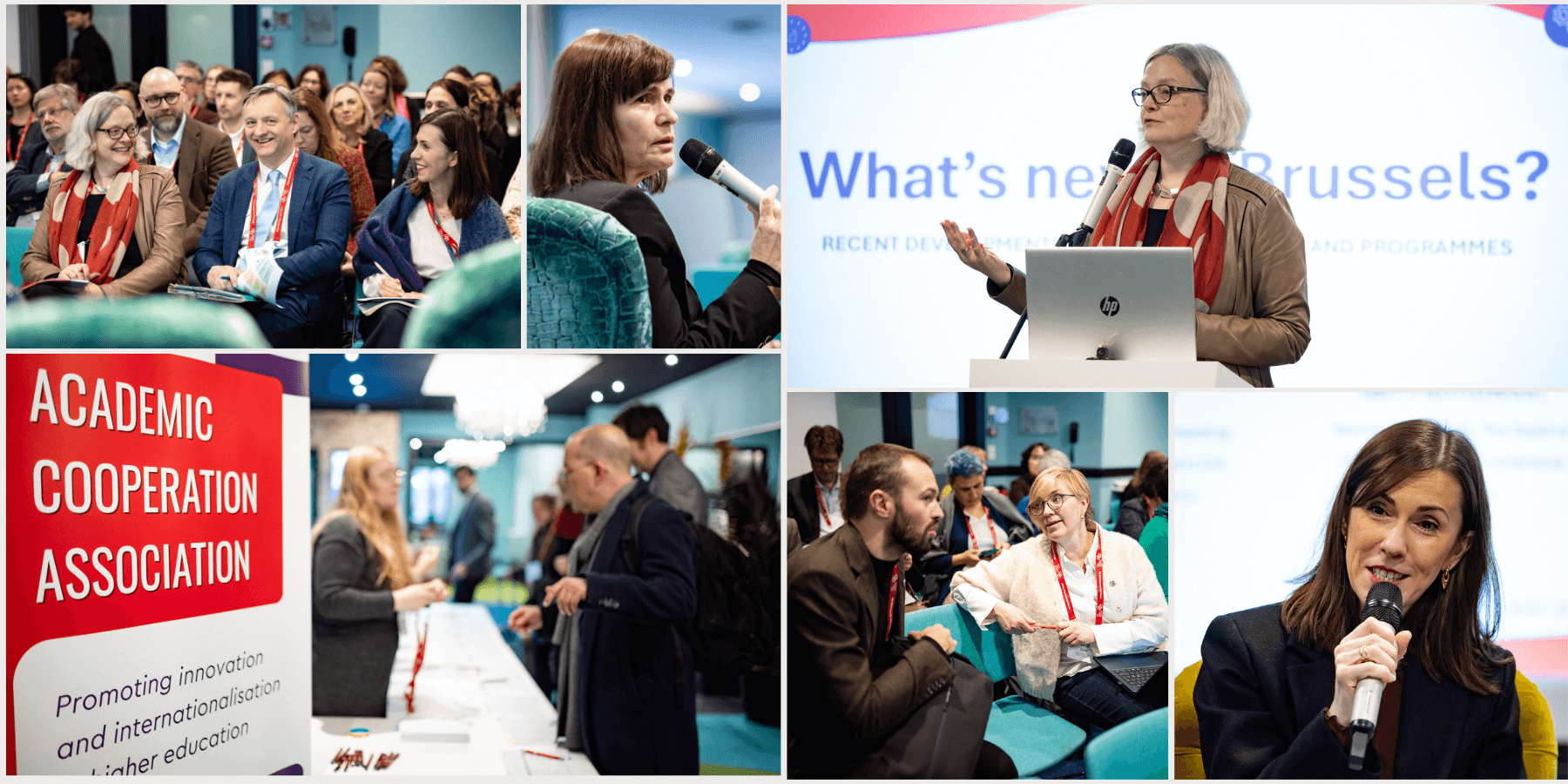
The following messages emerged from expert discussions in smaller groups:
Horizontal priorities
- The European degree label is entering its final preparation stage. Experimentation calls are mobilising institutions to explore possible pathways and encouraging national authorities to remove existing barriers, while further clarifying the interpretation of the already adopted criteria.
- As the European Commission uses the current period to provide bridge funding and assess overall impact, European Universities alliances are already developing bottom-up sustainability mechanisms, including dedicated strategies, stronger coordination structures, and specific roles focused on synergy management, call scanning and support for academic staff. National Agencies play an important supportive role, notably through initiatives such as the Future4Alliances project, and through a wide range of support measures, as highlighted in the recent ACA–CMEPIUS study on national-level support to HEIs participating in European Universities alliances (for more information, see ACA Newsletter – Education Europe, January 2026).
- Significant progress has been made in recent years on the interoperability of university digital systems, supported by guiding frameworks at European and national level. However, fragmentation across multiple digital frameworks remains, alongside persistent organisational and legal challenges related to the development and use of shared digital platforms.
- Inclusion & diversity: Participation of students with fewer opportunities in Erasmus+ has noticeably increased (from 16.4% in 2022 to 21.4% in 2025), as has the share of top-up grant recipients (from 14.4% to 19.5%), pointing to the programme’s growing effectiveness in addressing inclusion-related needs. Institutional experience highlights a growing number of students requiring psychological support or living with hidden disabilities and emphasises the need for dedicated teams, clear service structures, and awareness-raising.
Geographic priorities
- The adoption of the Pact for the Mediterranean sets cooperation with the South Mediterranean region on a new path. For the first time, an EU cooperation framework places strong emphasis on the people dimension, encompassing higher education cooperation, mobility, and joint degrees, and signalling a shift towards more reciprocal partnerships.
- Erasmus+ continues to serve as a strategic tool for reform in EU Neighborhood and enlargement countries, including through capacity building for National Agencies. Discussions also focused on how the Ukrainian higher education sector can move from “survival mode” to “transformation mode”, highlighting the key role of European higher education institutions in this process.
- Cooperation with developing countries: A clear shift is underway from donor-driven approaches towards more equal partnerships, framed by the five pillars of the Global Gateway strategy. Erasmus+ is closely aligned with these priorities, notably through capacity-building in higher education (CBHE) and country- and region-specific investment priorities. This alignment is particularly relevant for applicants, with new calls on study and research in Africa expected between the end of this year and early 2027, alongside other Global Gateway-related opportunities. National Agencies play a key role in disseminating these opportunities and supporting new cooperation paradigms, including public–private partnerships, while engagement in the Team Europe approach is essential to effectively deliver on Global Gateway priorities.
Join us for post-event discussions on ACA LinkedIn page and book your calendars for the next year’s event!